First Kiteboard Buyers Guide: Twin Tip vs Surfboard for UK Conditions
Your lessons are behind you. You can water-start, ride both ways and hold an edge upwind on a decent day. Now you need your own board, and the first real decision is twin tip or surfboard. Both are kiteboards and both will get you on the water, but they reward very different things — and in the UK they suit very different days.
Before you look at a single board, be honest about your local conditions. Most UK riders deal with wind that arrives in gusts rather than a steady push, short steep chop on open water, and waves that are usually windswell with a tight period rather than clean lines. That combination shapes everything.
Ask yourself two questions. How many sessions a year am I genuinely riding in waves? And how much of my time is spent on flat or choppy water — an estuary, a harbour, a reservoir, a sheltered bay? For plenty of riders the honest answer to the first question is "a handful", and the second is "almost everything". Buy for the second answer, not the first, and you'll spend far more time riding and far less time sitting on the beach watching.
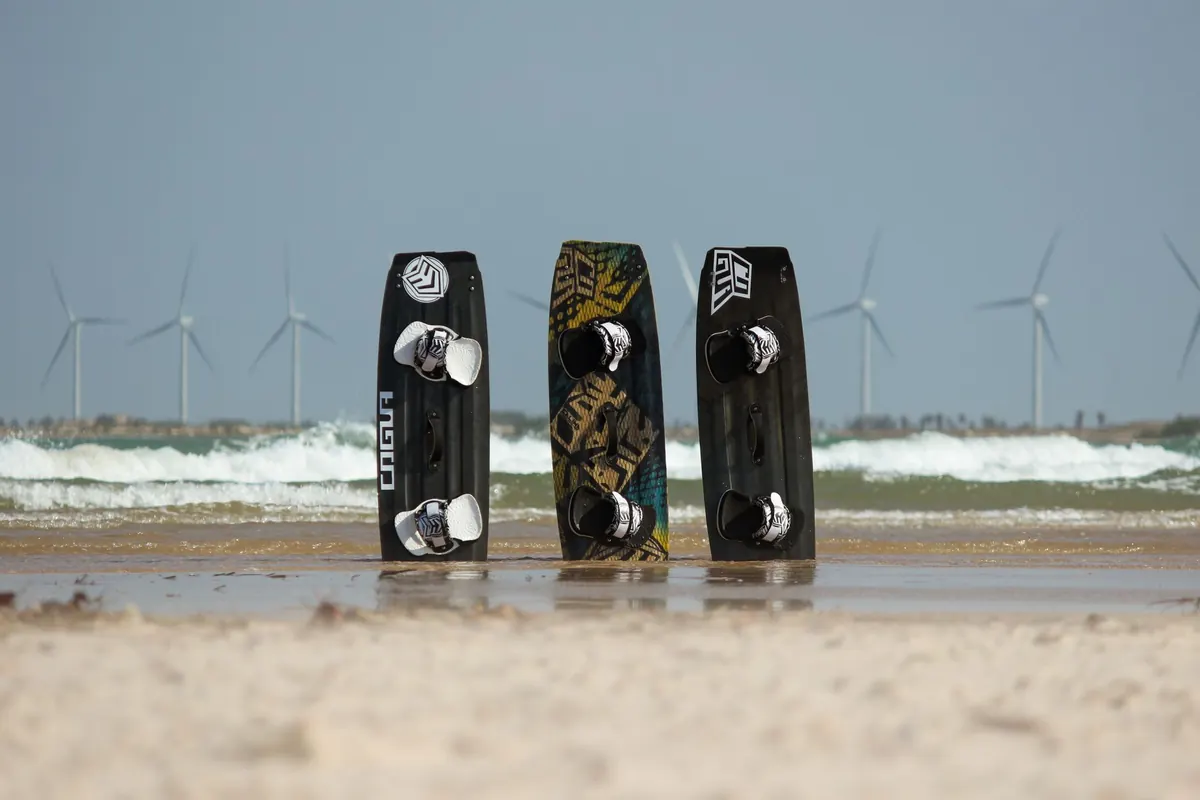
A twin tip is symmetrical, ridden with both feet pointing across the board, and it's the design nearly every kitesurfer learns on. It planes early, points upwind without drama, survives being dragged across shingle and, crucially, lets you concentrate on the kite rather than on your footwork.
Length is the headline number, but width does more for your progression. A wider board planes earlier and gets upwind in lighter wind, which matters enormously when your local forecast is 14 knots gusting 22. A narrower one is faster once you're powered and edges harder.
As a rough guide for an average adult on an average kite:
If you're between sizes and you ride gusty inland wind, go bigger. A board that's slightly too large will still be fun in two years. A board that's too small means you sit out the light days entirely.
Rocker is the curve running tip to tip. More curve means the nose lifts over chop and landings feel softer, but the board is slower and works harder to get upwind. Less curve means it planes early and feels fast, but it catches in messy water.
You'll also see continuous rocker and three-stage rocker. Continuous is a smooth, even curve — forgiving, comfortable in chop and the better choice for a first board. Three-stage flattens through the middle with a kick in the tips; it loads up for jumps and lands well, but it's less settled in rough water and less forgiving while you're still building technique.
Flex follows the same logic. A softer flex suits lighter riders and choppy conditions. A stiff board is for heavy, aggressive riders who want load and pop. For most first boards, medium is right.
A kite surfboard is usually 5'4" to 6'2", with less volume than a prone surfboard of the same length because the kite does the paddling for you. You'll see thrusters for drive and control, and quads for speed and looseness. Some riders use straps; many go strapless.
What a surfboard gives you is feel. It carves off the top, smooths out chop because of its length and outline, and handles gusty wind gracefully — you can edge and bleed power instead of fighting it. On a proper wave day, nothing else compares.
What it costs you is patience. Strapless riding means learning to tack and gybe, and to get going again after a wipeout without the crutch of a strap. Boards are more fragile than twin tips, more expensive, and slower upwind when you're underpowered. And if your local waves are onshore mush, a surfboard won't turn bad surf into good surf — it will simply make the mush harder work. A surfboard is a brilliant second board and a frustrating first one.
Second-hand twin tips are one of the best value buys in kitesurfing. Inspect the rails for splits, check around the footstrap inserts for cracks or soft spots, spin the fins to feel for damage, and look at the pads and straps — replacing them adds up. Ask what weight and wind range the seller used it in, too. If the board has been ridden by someone fifteen kilos lighter or heavier than you, that's useful context.
Buy from a shop or a local rider where you can ask questions and, ideally, try the board before you commit. Think about how the board pairs with your kite: a huge board with a small kite is a light-wind setup, while a small board with a big kite will overpower you quickly. Keep to a budget you're comfortable with; there's no reason to stretch for the newest shape when the used one down the road will teach you just as much. And if you have an old injury or a shoulder that complains, get proper advice from a physio before spending a season learning to tack strapless.
For the vast majority of UK riders, a first board should be a twin tip in the 136–142cm range, generous in width, with a moderate continuous rocker and a medium flex. It will plane early in gusty wind, cope with chop, survive the learning process and let you focus on your kite skills. Ride it for a season or two, get comfortable, then add a surfboard when you know you'll use it.
If you already live ten minutes from a wave that works, a surfboard can make sense from the start — but go in knowing the learning curve is longer and the rewards come later. Either way, buy for the wind and water you ride most often, not the conditions you hope for.
Photo: Harold Granados / Pexels
Previous Post
UK Winter Kitesurfing Checklist: What to Wear and Pack for Cold Water Sessions
Next Post
Tides and Kitesurfing: How to Plan a Safe Session Around High and Low Water